
I read this book during the pandemic, when I was out of work and disoriented about my identity after job titles were stripped away from me. Writing this now reminded me of the hours I spent watching the blue skies, letting the clouds pass me by, while tugging hard and keeping our goat Dolly from eating my mother’s houseplants. The timing wasn’t intentional—I stumbled across it while looking for something, anything, to make sense of the upheaval.
What I found was both comforting and unsettling.
Feiler argues that we’ve been conditioned to believe life follows a predictable path: childhood, education, career, family, retirement—invisible deadlines we’re supposed to meet. A steady climb upward. And yet, when I looked at my own life—and the lives of people around me—I saw something else entirely. Disruption. Setbacks. Sudden changes that didn’t fit the script.
The book’s central thesis is simple but profound: life is in the transitions, not in the stable phases between them. The transitions are the life, not interruptions to it.
Perhaps it’s because I was living through one of those transitions that this resonated so deeply. I felt less like I was failing at following the path and more like I was simply… living.
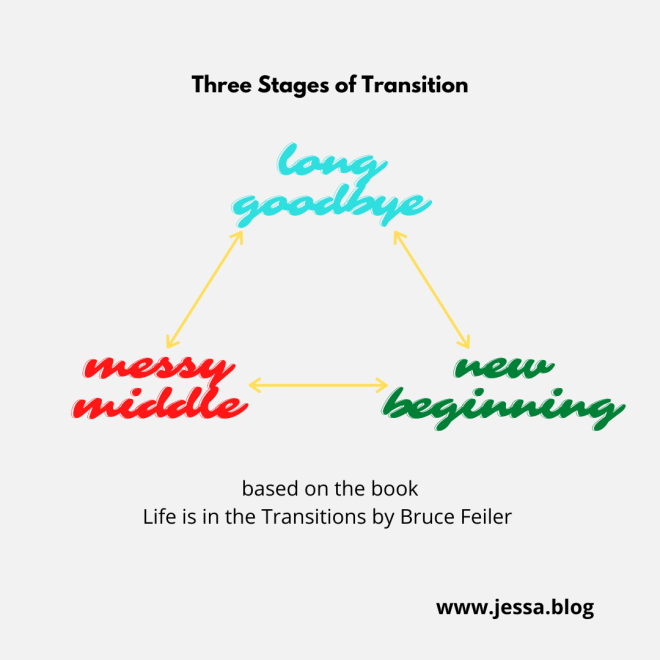
Feiler calls these forceful bursts of change “lifequakes”—those moments when everything shifts beneath you. I can remember how many of these I’ve already experienced, like shifting sands beneath my feet. The pandemic was one, obviously. But there were others before it, and new ones that came after it, and I suspect there will be more ahead.
Rather than seeing them as aberrations to avoid, Feiler suggests they’re inevitable. The question isn’t whether we’ll face them, but how we’ll navigate them when they come.
He introduces a framework he calls the ABCs of meaning: agency (your ability to impact the world), belonging (your connections to others), and cause (your sense of purpose beyond yourself). I found myself mentally auditing my own life against these three dimensions. Where was I strong? Where was I depleted and hopeless? During the pandemic, my sense of agency felt particularly shaken. I had so little control over what happened next.
Feiler also talks about the three types of stories we tell about our lives: our individual hero story (the “me” narrative), our communal story (the “we” narrative), and our service story (the “thee” narrative, where we’re part of something larger). The balance between these shapes our sense of fulfillment.
What struck me was how, during life transitions, these narratives can get scrambled. When I lost my job, my “me” story felt broken. It pushed me to ask questions I never considered before—questions about identity I’d always taken for granted. But maybe that’s when the other two narratives matter most: the connections to others, the contribution to something beyond yourself.
Taking care of our goat Dolly sure did keep me grounded and allowed me to stick to a routine that kept me going every day.
What I appreciated most about the book was Feiler’s refusal to prescribe a single method for navigating transitions. He offers tools—ritualizing changes, shedding old mindsets, seeking wisdom from others—but acknowledges that not everyone uses every tool, and they don’t follow a strict sequence. Very fitting for a book about nonlinearity.
One idea that stayed with me: children who hear “oscillating family narratives”—stories of both successes and setbacks—are better equipped to handle life’s disruptions than those who only hear tales of uninterrupted ascent or decline. It made me think about the stories we tell ourselves and our children. About how my own family stories enabled me to be resilient in life transitions. Maybe honesty about the ups and downs is a gift, not a burden.
The book freed me from the expectation that I would ever “arrive” at stability. Maybe that’s not the goal. Maybe the goal is developing fluency with change itself—learning to dance with uncertainty rather than resist it. Who knew that was a skill we’d need to cultivate?
Feiler provides both perspective and practical tools. But more than that, he offers permission to stop waiting for life to return to “normal” and start engaging with what actually is.
Have you read this book? What has been your experience with navigating major life transitions?
 jessa
jessa 