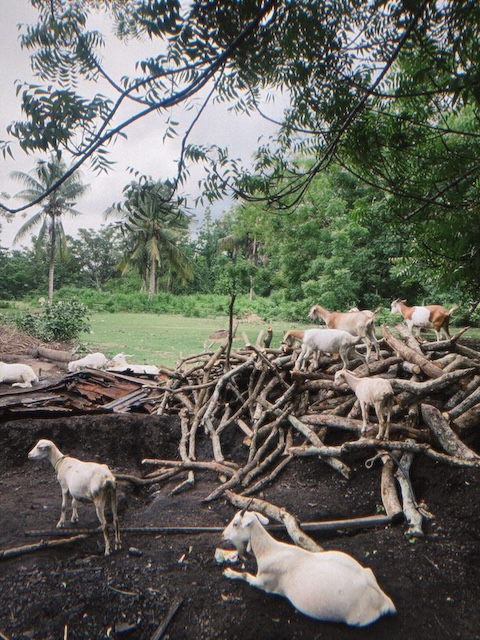
My grandmother, Lola Magda, has raised goats her whole life, so when I thought about raising one after finishing my master’s degree, she was the first person I called. But instead of giving me a step-by-step guide, she did something better: she had a goat delivered to my childhood home while I was still in the metro.
I only got to meet Dolly—that’s what I named her—when the pandemic lockdowns sent me home. Who wouldn’t want to be with family when the world is ending, right?
Before the world settled into whatever came after, I spent almost two years raising Dolly, and I even helped her deliver three kids in different breeding seasons. Lola Magda was right about giving me a goat so I could learn more about them and how to raise them. I realized that a textbook approach would only get me as far as tickling my imagination, but never really test my decision-making and problem-solving skills.
Before everything in the world bounced back to a new normal, I spent almost two years raising Dolly, and I even helped her deliver three kids in different breeding seasons. Lola Magda was right about giving me a goat so I could learn more about them and how to raise them. I realized that a textbook approach would only get me as far as tickling my imagination, but never really test my decision-making and problem-solving skills.
Living with and raising sentient beings such as goats stretched my ability to work with animals beyond the skills I had learned from living among chickens, cats, and dogs. At the same time, because this was during the pandemic—when the world was going through many crazy changes—raising goats became my tether, especially when I was still figuring out where to go with my career. Dolly and her kids gave me purpose, and they became the reason why I looked forward to getting up every day.
Here are the things I learned about goats by raising them:
- Goats are creatures of routine. As soon as the sun breaks at around six in the morning, or when Dolly would hear me up and about in my room, she would bleat to let me know that it’s breakfast time.
- Goats are good communicators. After some blank staring ahead and chewing the cud after breakfast, Dolly would bleat to let me know she wanted to be transferred to another area with new grass, and bleat again when she wanted to be transferred to yet another area with new grass. She would bleat to ask for more water, if she gets tied up, and if she wants to go home.
- Goats are cunning. There’s this area in our front yard that has all the fresh grass Dolly likes, but because our houseplants are also within her reach, she really has to be supervised, or else she would run amok and just eat Mama Belen’s plants, to mama’s disapproval and disappointment, of course. So in late afternoons, when I go out to read a book, I let Dolly eat the grass in our front yard, near our houseplants. When I would notice that she wanders too near them, I would simply tug her back, and she would back off. Like a dance, Dolly learned how to keep in step with me, and then trick me when I least expect it. Because there were moments when I just blinked or turned, she would pretend to eat the grass near the houseplants and then stick her tongue out on the leaves at the right moment when I was not looking, and chew on them and through the whole plant as quickly as she could before she got noticed. I always fall into her cunning ability to pretend she is not plotting anything. 😅
- Goats are dogs with hooves. I never thought that goats were like dogs that would wag their tails whenever they are happy to see you. Whenever we arrived home, Dolly would always give us a greeting, some tail wagging, and even run towards us as a dog would. If she gets extremely happy, like when she sees that you are bringing some treat like mango peels and mango tree leaves, she would make these small hops, letting you know she’s happy.
- Goats get gassy too. Through Dolly, I also learned how to help a goat find relief when bloated. There was one morning when Dolly wasn’t her usual self. She just wanted to sit all day long and not eat grass. I also noticed how her abdomen felt too rigid to the touch, like a balloon about to pop. After I gave Lola Magda a worried call, she told me that Dolly must be bloated and that I must give her flank a gentle massage. It was an awesome learning experience because as I kept giving Dolly a flank massage, I heard her let out a satisfying fart. 😂 Later that day, Dolly looked well, which gave us relief.
- Goats have an average gestation period of five months. After borrowing a friend’s male goat to get Dolly pregnant, we weren’t sure whether it had been successful. Lola Magda taught me three visual cues to help me determine whether Dolly is pregnant. First, an enlarged udder. Then, a relaxed ligament near the tail. Lola taught me to check it by squeezing the ligaments near Dolly’s tail. If it feels soft and relaxed to the touch, then Dolly will be having her kids soon. And the only way I noticed the changes was by constantly touching the ligament near her tail during the last month of her pregnancy. The final signs would be vulva swelling and vaginal discharge, especially when she is almost due. We also noticed she has become extra sweet, not the sassy Dolly she usually is.
- Goats have pre-labor behaviors. When Dolly was extremely pregnant, she would waddle as she walked, spreading her hind legs to make room for her enlarged udder. Her sides also begin to hollow out too. And then we begin to notice her restlessness and occasionally pawing at the ground.
- When kidding, ensure that the placenta is delivered. I learned that if the goat failed to deliver the placenta, it would cause health issues and even lead to death.
- Goat mothers are as caring as mothers can be. It was a marvel to see how Dolly really embraced motherhood. She would lick her kid’s rear end, like humans changing a baby’s diaper, and communicate with her kids. I also learned about how kids are really playful, like toddlers running about, curious about the world. When her kids were growing up, I noticed how Dolly doesn’t bleat to call for our attention anymore, especially when she needs something. Her kids start bleating for her, or did she tell them so?
When I had to return to the metro for work, I had to leave Dolly and her kids behind. But the lessons I learned along the way will be with me wherever I go—especially the one Lola Magda gave me before any of it started:
The best way to learn is to just begin.
Leave a Reply