For two days, I’ve sat in conference halls listening to academics share their research findings—one presentation of data and models after another—and I can’t help but wonder how we can make our work pique others’ interest without losing them in all the jargon.
Are academic conferences supposed to be technical all the time? Or can we use common words to connect with people who deeply care?
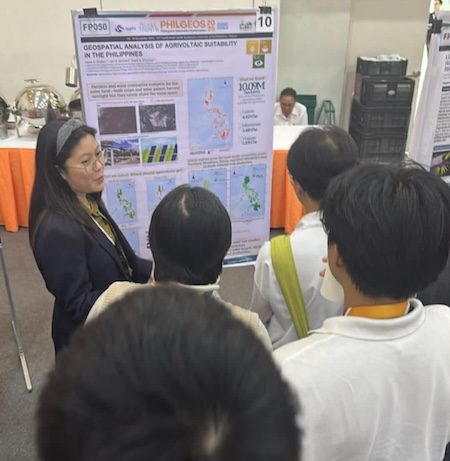
I didn’t have answers to these questions until I stood beside my poster, watching people approach.
The poster format gave me something the podium never did: flexibility. I could share stories about my research without drowning anyone in technical details—unless they asked, which almost no one did.
For an hour, I experimented.
I told them that both solar panels and crops require the same sunlight but rarely share the same space, and that agrivoltaics aims to resolve the land-use conflict between agricultural production and energy generation.
I tried different ways of explaining the same work, watching faces, listening to questions, noticing which phrases made people lean in and which made their eyes glaze over.
The most helpful feedback came from someone who thanked me for “the trivia”—the fun fact, the thing worth remembering.
I laughed when she said that because it was so unexpected. Because of the many things I mentioned about agrivoltaics, what she most remembered was when I told her that the solar panels in agrivoltaics provide crop shade, benefiting the crops under them, like how a Madre de Cacao provides shade to plantation crops such as cacao. Before our conversation, she thought Madre de Cacao was similar to the cacao plant. Now she knew the difference. She walked away with new knowledge—not just about agrivoltaics, but about a tree and its relationship to another plant. And somehow, that small piece of new information gave her a way to understand the solar panels in agrivoltaics, too.
Of all the technical terms I could have emphasized, what created understanding was introducing her to something entirely new but graspable. Maybe that’s the answer to my question. Maybe connecting isn’t about simplifying our academic work, but about offering people something new they can actually picture, something that bridges what they’re learning with a world they can imagine.
Maybe people don’t need us to be less technical. They just need us to give them something concrete to hold onto—a new word, a new relationship between things, a new image—as they make sense of the unfamiliar.
 jessa
jessa 
Start the conversation