There are days when I miss the cool of my hometown. It isn’t even summer here in the metro, but the urban heat is often too much to bear (much worse during the summer), affecting my productivity and engagement.
Data shows that it will only get worse.
As global temperature rise, urban residents may experience something like hell. “The trends are very harmful to an increasing share of people living in cities,” notes Belgian scientist Hendrik Wouters. “Hot temperatures lead to excessive mortalities, hospital admissions, energy usage and economic loss, which are exacerbated by the urban heat island [effect].”
2030: How Today’s Biggest Trends Will Collide and Reshape the Future of Everything by Mauro F. Guillén
What causes urban heat islands?
From this MIT explainer on urban heat islands:
As cities grow, new development such as roads and buildings displace natural surfaces like trees, ponds, and soil. This change in the local environment results in a corresponding change in the local climate. That’s because these natural surfaces help moderate air temperatures.
Trees and other plants, for instance, can lower air temperatures by providing shade. This vegetation, along with soil and water, also helps cool nearby air through “evaporative cooling,” which is a natural process by which evaporating water absorbs heat (much like sweat cools the human body).
The man-made surfaces that replace these features, however, tend not to have cooling effects. Instead, they tend to absorb and re-emit more heat, which makes their surroundings warmer too. Though much of that heat comes from the sunlight those surfaces receive, another source of heat is human activities—like power generation and the use of cars and air conditioners. The geometry of cities also contributes to heat islands: the narrow spaces between tall structures, known as urban canyons, can block wind and trap heat.
Urban heat islands in the Philippines
While I was exploring about urban heat, I looked into studies that considered urban heat islands in the Philippines and this study found that “the cities at high or very high risk are found in Metro Manila, where levels of heat hazard and exposure are high.”
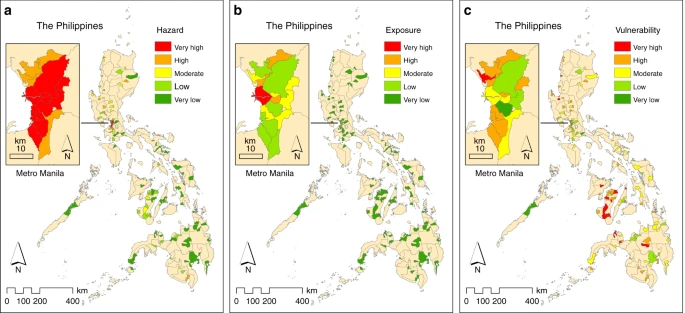
Estoque, R. C., Ooba, M., Seposo, X. T., Togawa, T., Hijioka, Y., Takahashi, K., & Nakamura, S. (2020). Heat health risk assessment in Philippine cities using remotely sensed data and social-ecological indicators. Nature Communications, 11(1), Article 1. https://doi.org/10.1038/s41467-020-15218-8
The figure above validated my yearning for the coolness of my hometown because it was classified as having very low heat hazard and exposure.
Another study reviewed some strategies to mitigate the adverse effects of urban heat islands and derived the following conclusions:
- Generally speaking, there are three elements to be considered in urban planning, which have a major impact on temperature variation in the city on a local scale: buildings, green spaces, and pavements.
- The distribution of the buildings and urban structures in a city affect the formation of the urban heat island, since this distribution usually determines the absorption of solar radiation and the formation of air flows.
- The combination of high buildings and narrow streets that entrap hot air and reduce the air flow generate low-velocity winds that do not disperse suspended particles and polluting gases. This is conducive to the heat island effect.
- To counteract or mitigate the heat island effect, if measures are applied to urban elements affecting temperatures on a local scale, various parameters can be used to evaluate the potential impact produced by the modification of urban morphology on energy consumption, and thus reduce CO2emissions into the atmosphere.
- The application of measures to counteract or mitigate the heat island effect depends on a wide range of factors, some of which can be incorporated into planning strategies, whereas others are outside the scope of the use and geometry of spaces.
- The research studies analyzed conclude that parks and green spaces help to mitigate the heat island effect and reduce energy consumption for cooling buildings in the summer, besides stabilizing the fluctuation of temperatures caused by building materials. However, it is not clear how the characteristics of the park affect the formation of the cold island. As a result, certain authors affirm that depending on the climate of the site, the tree species, and the number of trees in relation to the surface area, parks and green spaces can produce an increase or reduction in the energy consumption of nearby buildings.
- Vegetation cover improves the energy performance of buildings as well as the environmental conditions of the surrounding area.
- An effort should be made to systematize all current knowledge concerning the effects that greenery has on the urban microclimate. This would greatly facilitate the work of architects and engineers in charge of urban design.
 jessa
jessa 